Biyernes, Nobyembre 25, 2016
STORY OF MADAI
http://www.gutenberg.org/files/27114/27114-h/27114-h.html#toc17
Madai, the third son of Japhet, was the progenitor of the Medes, whose territory extended from the Caspian Sea on the north, to the mountains of Persia on the south, and from the highlands of Armenia and the chain of Tagros on the west, to the great desert of Iran on the east. It comprised a great variety of climate, and was intersected by mountains whose valleys were fruitful in corn and fruits. “The finest part of the country is an elevated region inclosed by the offshoots of the Armenian mountains, and surrounding the basin of the great lake Urumizu, four thousand two hundred feet above the sea, and the valleys of the ancient Mardus and the Araxes, the northern boundary of the land. In this mountain region stands Tabris, the delightful summer seat of the modern Persian shahs. The slopes of the Tagros furnish excellent pasture; and here were reared the famous horses which the ancients called Nisæan. The eastern districts are flat and pestilential, where they sink down to the shores of the Caspian Sea; rugged and sterile where they adjoin the desert of Iran.” The people who inhabited this country were hardy and bold, and were remarkable for their horsemanship. They were the greatest warriors [pg 089]of the ancient world, until the time of the Greeks. They were called Aryans by Herodotus. They had spread over the highlands of Western Asia in the primeval ages, and formed various tribes. The first notice of this Aryan (or Arian) race, appears in the inscriptions on the black obelisk of Nimrod, B.C.880, from which it would appear that this was about the period of the immigration into Media, and they were then exposed to the aggressions of the Assyrians. “The first king who menaced their independence was the monarch whose victories are recorded on the black obelisk in the British Museum.” He made a raid into, rather than a conquest of, the Median country. Sargon, the third monarch of the Lower Empire, effected something like a conquest, and peopled the cities which he founded with Jewish captives from Samaria,B.C. 710. Media thus became the most eastern province of his empire, but the conquest of it was doubtless incomplete. The Median princes paid tribute to the kings of Nineveh,

Huwebes, Nobyembre 24, 2016
NEBUCHADNEZZAR KING OF BABYLON
http://www.aina.org/books/eliba/eliba.htm#c18
NEBUCHADNEZZAR
KING OF BABYLON

Northern Kingdom of Israel assyrian captivity
http://6exodus.com/uncategorized/assyrian-captivity/
In the days of Pekah king of Israel came Tiglathpileser king of Assyria, and took Ijon, and Abelbethmaachah, and Janoah, and Kedesh, and Hazor, and Gilead, and Galilee, all the land of Naphtali, and carried them captive to Assyria. (II Kings)
In 722 BC, nearly twenty years after the initial deportations, the ruling city of the Northern Kingdom of Israel, Samaria, was finally taken by Sargon II after a three-year siege started by Shalmaneser V.
the king of Assyria found conspiracy in Hoshea: for he had sent messengers to So king of Egypt, and brought no present to the king of Assyria, as he had done year by year: therefore the king of Assyria shut him up, and bound him in prison. Then the king of Assyria came up throughout all the land, and went up to Samaria, and besieged it three years
In the ninth year of Hoshea the king of Assyria took Samaria, and carried Israel away into Assyria, and placed them in Halah and in Habor by the river of Gozan, and in the cities of the Medes. (II Kings 17:3–6)
//
In the days of Pekah king of Israel came Tiglathpileser king of Assyria, and took Ijon, and Abelbethmaachah, and Janoah, and Kedesh, and Hazor, and Gilead, and Galilee, all the land of Naphtali, and carried them captive to Assyria. (II Kings)
In 722 BC, nearly twenty years after the initial deportations, the ruling city of the Northern Kingdom of Israel, Samaria, was finally taken by Sargon II after a three-year siege started by Shalmaneser V.
the king of Assyria found conspiracy in Hoshea: for he had sent messengers to So king of Egypt, and brought no present to the king of Assyria, as he had done year by year: therefore the king of Assyria shut him up, and bound him in prison. Then the king of Assyria came up throughout all the land, and went up to Samaria, and besieged it three years
In the ninth year of Hoshea the king of Assyria took Samaria, and carried Israel away into Assyria, and placed them in Halah and in Habor by the river of Gozan, and in the cities of the Medes. (II Kings 17:3–6)
//
kingdom of Judah, was captured by King Nebuchadnezzar
http://www.johnpratt.com/items/docs/captivity.html
Jehoiachin (also called Jeconiah), king of Judah, was captured by King Nebuchadnezzar and taken to Babylon, along with some 10,000 of Jerusalem's principal citizens (see 2 Kgs. 24:12-16). After they arrived in Babylon, the prophet Jeremiah wrote them a letter telling them to build houses and plant gardens. He prophesied, "For thus saith the Lord, That after seventy years be accomplished at Babylon I will visit you, and perform my good word toward you, in causing you to return to this place" (Jer. 29:10)
Jehoiachin (also called Jeconiah), king of Judah, was captured by King Nebuchadnezzar and taken to Babylon, along with some 10,000 of Jerusalem's principal citizens (see 2 Kgs. 24:12-16). After they arrived in Babylon, the prophet Jeremiah wrote them a letter telling them to build houses and plant gardens. He prophesied, "For thus saith the Lord, That after seventy years be accomplished at Babylon I will visit you, and perform my good word toward you, in causing you to return to this place" (Jer. 29:10)
Phoenicians and Greeks; Kymrians that reached Gaul
http://www.gutenberg.org/files/11951/11951-h/11951-h.htm
Phoenicians and Greeks; Kymrians that reached Gaul
the Greeks alone does history mark with any precision the arrival in southern Gaul. The Phoenicians preceded them by several centuries
The Iberians, whom Roman writers call Aquitanians, dwelt at the foot of the Pyrenees, in the territory comprised between the mountains, the Garonne, and the ocean. They belonged to the race which, under the same appellation, had peopled Spain
They had begun about 1100 B.C. to trade there. They went thither in search of furs, and gold and silver, which were got either from the sand of certain rivers, as for instance the Allege (in Latin Aurigera)
As merchants and colonists, the Greeks were, in Gaul, the successors of the Phoenicians, and Marseilles was one of their first and most considerable colonies. At the time of the Phoenicians’ decay in Gaul, a Greek people, the Rhodians, had pushed their commercial enterprises to a great distance, and, in the words of the ancient historians, held the empire of the sea. Their ancestors had, in former times, succeeded the Phoenicians in the island of Rhodes, and they likewise succeeded them in the south of Gaul, and founded, at the mouth of the Rhone, a colony called Rhodanusia or Rhoda,
Sabado, Nobyembre 19, 2016
JESUS was born in the year 749
http://www.gutenberg.org/files/36264/36264-h/36264-h.htm
==============================================


The death of Herod the Great on the year of Christ's birth however Jesus was born while Herod was still living.
Herod died thirty-seven years after he was declared king by the Romans. In 714
Herod died shortly before the Passover of 750
Preceding Herod's death. two years from the reign of Tiberius on the theory that Tiberius was contemporary ruler with Augustus for two years. But he finds difficulty in lengthening Herod's reign set. Our present era makes the birth of Christ in the year of Rome 754
Jesus was at least two or three years old when Herod slaughtered the infants in Bethlehem, Matt. 2:16. the massacre took place some months before Herod's death which would bring the Saviour's birth back some time into the year 749
The appearance of the "star in the east" agree in time with the slaughter of the children,since the star looked upon as a supernatural phenomenon, and not the wise men's interpretation of a natural conjunction of planets this conjunction have been the bright star that led on the wise men The Chinese records preserve the account of the appearance of a comet in the spring of 749.
The word used is aster, star, and not astron, a group of stars.
the star first appeared to the wise men two years before their visit, and a second time on their visit to Bethlehem.
the star is said to have stood over "where the young child was,If it were a natural star it would have kept going as they went, and would not have stopped till they stopped. Even then it would appear as far away as ever from Bethlehem. It was therefore, a miracle
the reign of Tiberius begin August 29, 781 "Tiberius is adopted by Augustus as his son, and colleague in empire." Tiberius reigned jointly with Augustus about two years before he assumed full control of the empire Tiberius' power was already equal to that of Augustus in the provinces two years before his death
The apostle Luke would naturally use the provincial point of view. Taking off the two years from the joint reign of Augustus
The age of Jesus at his entrance upon his ministry, he began to teach, was about thirty years of age."
the enrollment should have taken place according to the Jewish and not according to the usual Roman method, because Herod would wish it to be in accordance with the customs of his kingdom. So every one went to his own city.
Martes, Nobyembre 15, 2016
PARTVII 4 TURKEY AND THE WAR
https://www.gutenberg.org/files/51761/51761-h/51761-h.htm
TURKEY AND THE WAR
It is a well-known fact that Germany, while carefully organising the conflict that was to lay waste the whole world and give her the hegemony of the globe, had not neglected Turkey. Her manœuvres ended, before the war, in concluding a Turco-German treaty of alliance, signed in Constantinople at four o’clock in the afternoon of August 2, 1914, by Baron von Wangenheim and the Grand Vizier Said Halim, an Egyptian prince, cousin to the former Khedive of Egypt and Mehemet Ali’s grandson. It seems that the Turkish negotiators had plainly told the German representatives that they only meant to fight against Russia, and they did not even require any guarantee against the action of France and England.
The spirit in which these negotiations were carried on has been lately corroborated by a statement of M. Bompard, former French Ambassador at Constantinople, who, in answer to a newspaper article concerning the circumstances under which Turkey entered into the war, and the episode of the Goeben and the Breslau,10 wrote in the same newspaper:11
“Owing to the treaty of August 2, Turkey was ipso facto a belligerent; yet though the military authorities acted in30 conformity with the treaty, the civil authorities—i.e., the Government, properly speaking—had a somewhat different attitude. In the first place, the Government denied it was at war with France and England. The Grand Vizier had even made a formal declaration of neutrality in Paris and London; it only had to do with Russia; besides, the thing was not urgent, as the Russian decree of mobilisation had just been issued.”
In the first article of the treaty it was stated that both Powers should maintain a strict neutrality in the conflict between Austria-Hungary and Serbia. This clause, however, was only intended to give the treaty a pacific appearance, for it was said in Clause 2 that if Russia intervened and thus compelled Germany to support her ally, Austria-Hungary, Turkey should be under the same obligation.
Now, on the previous day, Germany had declared war on Russia, and thus the second article came into effect immediately. So by this treaty Germany really wanted to throw Turkey into the war by the side of the Central Powers.
The other clauses laid down the conditions of a military co-operation. The most important one was that Turkey pledged herself to let the German military mission have the control in the conduct of operations, “according to what was agreed between His Excellency the War Minister and the President of the Military Mission.” Theoretically the treaty was to come to an end on December 31, 1918, but, if not denounced six months before that date, it was to be renewed for five years more.
Clause 8 and last expressly said that the agreement was to be kept secret.
On October 29, 1914, two Turkish torpedo-boats entered the port of Odessa, sank a Russian gun-boat,31 and fired at the French liner Portugal, and a Turco-German squadron made a surprise attack upon Theodosia and Novorossisk. Then the Allied Powers declared war on Turkey on November 5.
Yet, after keeping neutral during the first three months of the war, Turkey seems to have had some hesitation in entering the conflict, notwithstanding German pressure. Most of her statesmen, who had weighed the financial and political consequences of her intervention, did not seem to consider they were to the advantage of their country; but the ambitious aims of Enver Pasha, who was devoted to Germany, for his success depended on her triumph, prevailed upon Turkey to yield. On the other hand, the Grand Vizier, Said Halim Pasha, pointed out on October 2, 1914, to the Austrian ambassador, who urged Turkey to utilise her fleet, that if the latter was ever defeated by the Russian fleet, Constantinople would be endangered. But a few days after, on October 15, he declared that the only obstacle to Turkish intervention was the penury of the treasury. Indeed, it is probable that Javid Bey, Minister of Finance, who had just signed an agreement with France concerning Turkish railways and finance, was not very eager to declare war on a country whose financial help was indispensable. He had even made overtures on several occasions to the ambassadors of the Entente, on behalf of the moderate members of the Ministry. In August, 1914, he offered to come to an agreement with the Entente providing that the Capitulations were suppressed, and in September he asked them to recognise the suppression of the Capitulations in order to be able to32 demobilise the Ottoman army. He resigned after the declaration of war, but consented to be member of a new Cabinet the next year.
It seems probable, too, that Talaat for rather a long time favoured an attitude of neutrality in order to obtain for Turkey, among other political and economic advantages, the suppression of the Capitulations, and that only later on he finally, like Jemal, Minister of Marine, sided with Enver Pasha and the Germans. On September 6 Talaat Bey told Sir L. du Pan Mallet that there was no question of Turkey entering the war,12 and on September 9 he declared to the same ambassador, with regard to the Capitulations, that the time had come to free Turkey from foreign trammels.13
Ghalib Kemaly Bey, Turkish Minister at Athens, in a telegram addressed to Said Halim Pasha on June 15, 1914, had informed him he had just learnt that “Greece, by raising a conflict, expected a general conflagration would ensue which might bring on the opening of the question of Turkey-in-Asia.” On August 7, 1914, he stated in another dispatch sent from Athens to the Sublime Porte:
“In the present war England, according to all probabilities, will have the last word. So if we are not absolutely certain to triumph finally, it would be a highly venturesome thing for us to rush into an adventure, the consequences of which might be—which God forbid—fatal to our country.”
In a long report dated September 9, 1914, he added:
“The present circumstances are so critical and so fraught with danger that I take the liberty humbly to advise the33 Imperial Government to keep a strict neutrality in the present conflicts, and to endeavour to soothe Russia....
“The compact lately signed in London by the Allies shows that the war is expected to last long.... A State like the Ottoman Empire, which has enormous unprotected sea-coasts and remote provinces open to foreign intrigues, should certainly beware of the enmity of a malignant and vindictive country like England....”
So it appears that the decision of Turkey was not taken unanimously and only after much hesitation.
Henceforth the operations engaged in by both sides followed their due course.
In Europe the Franco-British squadrons under the command of Admiral Carden began on November 3 to bombard the forts which guarded the entrance of the Dardanelles. On February 25, 1915, a combined attack of the Allied fleets took place, and on March 18 a general attack was made by the Franco-British squadrons, in which three of their ironclads were sunk, four were severely damaged, and other ships were disabled.
On April 25 to 27 the English and French troops landed in Gallipoli, and after driving back the Turks advanced on May 6 to 8. But when the expeditionary corps had failed to reach Krithia and the Kareves-Dere, then, after a violent offensive of the Turks, which was repulsed on June 21, and the failure of a diversion against the Sari-Bair Mountains, it was withdrawn on January 8, 1916.
In Asia, after the Turkish naval action in the Black Sea, and the march of the Turkish troops against Kars and Tiflis, the Russians invaded Armenia, in Asia Minor, on November 4, 1914, and took Ardost. On November 8 they captured Bayazid and Kuprikeui;34 Ardahan and Sary-Kamysh, where, as will be seen later on, the Armenians were partly responsible for the Turkish retreat, December 21 and 22; on May 19, 1915, Van fell; then, in the following year, Erzerum (February 16, 1916), Mush (February 18), Bitlis (March 2), Trebizond (April 18), Baiburt (July 16), and Erzinjan (July 25). Thus the Russian troops had conquered the four provinces of Erzerum, Van, Trebizond, and Bitlis, extending over an area of 75,000 square miles.
In Mesopotamia the British brigade of Indian troops came into action on November 8, 1914, and captured the little fort at Fao, which commands the entrance of the Shatt-el-Arab. On November 17 it was victorious at Sihan, took Basra on the 22nd, and Korna on December 9 of the same year. Next year, on July 3, 1915, the British troops captured Amara, Suk-esh-Shuyukh on July 21, Naseriya on the 25th of the same month, and on September 29 they occupied Kut-el-Amara, which the Turks recaptured on April 18, 1916, taking General Townshend prisoner. On February 28, 1917, Kut-el-Amara fell again to British arms, then Baghdad on March 11. On April 2, 1917, the English and Russian forces joined together at Kizilrobat on the main road to Persia, and all the Indian frontier was wholly freed from the Turco-German pressure.
But after the Russian revolution, the Turks successively recaptured all the towns the Russian troops had conquered in Transcaucasia and Asia Minor, and soon threatened Caucasus.
Meanwhile in Arabia the Turks had suddenly invaded the Aden area, where they were beaten on35 the 21st by the British at Sheikh-Othman and on the 25th at Bir-Ahmed.
On June 10, 1916, the Arab rising broke out. On June 14 they were masters of Mecca. On July 1 they took Jeddah, then Rabagh, then Yambo on the Red Sea. On November 6, 1916, the Sherif of Mecca, the Emir Hussein, was proclaimed King of the Hejaz, under the name of Hussein-Ibn-Ali.
As early as November 3, 1914, Turkey, which occupied all the Sinai Peninsula, threatened Egypt. A first Turkish offensive against the Suez Canal was checked from February 2 to 4 simultaneously before El-Kantara, Al-Ferdan, Toussoun, and Serapeum. A second Turkish offensive, started on July 29, 1916, was also crushed before Romani near the Suez Canal, on the 5th at Katia and on the 11th at Bir-el-Abd.
The British army then launched a great offensive in December, 1916, which resulted, on December 21, in the capture of El-Arish, on the boundary of the Sinaitic desert, and in the occupation of Aleppo on October 26, 1918. On January 9, 1917, they took Rafa, then Beersheba on October 31, 1917, Gaza on November 7, and Jaffa on November 17; and on December 11, 1917, General Allenby entered Jerusalem.
In September, 1918, a new offensive took place, backed by the French troops that took Nablus, and the French navy that made the British advance possible by bombarding the coast. General Allenby entered Haïfa and Acre on September 23 and Tiberias on the 24th, and on the 28th he effected his junction with the troops of the King of the Hejaz. He36entered Damascus on October 1 with the Emir Feisal, who commanded the Arabian army. On October 6 the French squadron sailed into the port of Beyrut, which was occupied on the 7th. Tripoli was captured on the 13th, Homs on the 15th, Aleppo on the 26th of October, 1918. By this time Syria, Lebanon, Mesopotamia, and Arabia had fallen into the hands of the Allies.
Meanwhile the disintegration of the Turkish troop was completed by General Franchet d’Espérey’s offensive and the capitulation of Bulgaria. Turkey applied to General Townshend—who had been taken prisoner at Kut-el-Amara—to treat with her victors. The negotiations of the armistice were conducted by Rauf Bey, Minister of the Navy; Reshad Hikmet Bey, Under-Secretary of State for Foreign Affairs; and Sadullah Bey, head of the general staff of the Third Army.
As early as 1916 Turkey of her own authority had suppressed the Capitulations—i.e., the conventions through which the Powers, as has been seen, had a right, amongst other privileges, to have their own tribunals and post-offices; and by so doing she had freed herself from the invidious tutelage of Europe.
The Ottoman Government, in a note sent on November 1, 1916, by the Turkish ambassadors in Berlin and Vienna to the German and Austrian Ministers of Foreign Affairs, notified to their respective Governments and the neutrals that henceforth they looked upon the two international treaties of Paris and Berlin as null and void.
Now the treaties of Paris in 1856 and of Berlin in37 1878 were the most important deeds that had hitherto regulated the relations between the Ottoman Empire and the other European Powers. The treaty of Paris confirmed the treaty of 1841, according to which the question of the closing of the Straits to foreign warships was considered as an international question which did not depend only on the Turkish Government.
The Berlin treaty of 1878, too, asserted a right of control and tutelage of the Powers over Turkey, and in it Turkey solemnly promised to maintain the principle of religious liberty, to allow Christians to bear evidence in law-courts, and to institute reforms in Armenia.
As the King of Prussia and the Emperor had signed the treaty of Paris, and the Austrian Emperor and the German Emperor had signed the treaty of Berlin, Turkey could not denounce these treaties without the assent of these two allied countries, which thus gave up the patrimonial rights and privileges wrested from the Sultan by Western Europe in the course of the last three centuries. This consideration accounts for the support Turkey consented to give the Central Powers and the sacrifices she engaged to make.
In order to understand the succession of events and the new policy of Turkey, the reader must be referred to the note of the Ottoman Government abrogating the treaties of Paris and Berlin which was handed on November 1, 1916, by the Turkish ambassadors in Berlin and Vienna to the German and Austrian Ministers of Foreign Affairs. This note, recalling the various events which had taken place, pointed out that they justified Turkey in casting38 off the tutelage of both the Allied Powers and the Central Powers:
“Owing to the events that took place in the second half of the last century, the Imperial Ottoman Empire was compelled, at several times, to sign two important treaties, the Paris treaty on March 30, 1866, and the Berlin treaty on August 3, 1878. The latter had, in most respects, broken the balance established by the former, and they were both trodden underfoot by the signatories that openly or secretly broke their engagements. These Powers, after enforcing the clauses that were to the disadvantage of the Ottoman Empire, not only did not care for those that were to its advantage, but even continually opposed their carrying out.
“The Paris treaty laid down the principle of the territorial integrity and independence of the Ottoman Empire; it also stipulated that this clause should be fully guaranteed by all the Powers, and forbade any meddling, either with the relations between the Imperial Government and its subjects, or with the interior administration of the Ottoman Empire.
“Nevertheless, the French Government kept on interfering by force of arms in Ottoman territory, and demanded the institution of a new administrative organisation in Lebanon. Then the Powers signatory to the treaty were compelled to participate in this action by diplomatic ways, in order not to let France have a free hand in carrying out her plans, which were contrary to the Paris treaty and paved the way to territorial encroachments.
“On the other hand, the Russian Government, pursuing a similar policy, held in check by an ultimatum the action of the Porte against the principalities of Serbia and Montenegro, where it had raised an insurrection, and which it had fully provided with arms, supplies, officers, and soldiers; and after demanding the institution of a new foreign administration in some Ottoman provinces and of a foreign control over their home affairs, it finally declared war against Turkey.
“In the same manner the clauses of the Paris treaty did not hinder either the French Government from occupying Tunis and turning this province of the Ottoman Empire into a French protectorate—or the English from occupying Egypt to become the ruling power there, and from encroaching upon Ottoman sovereignty in the south of the Yemen, in Nejed, Koweit, Elfytyr, and the Persian Gulf. In spite of the same clauses the four Powers now at war against Turkey have also recently modified the condition of Crete and instituted 39a new state of things inconsistent with the territorial integrity that they had guaranteed.
“Finally Italy, without any serious reason, merely in order to have territorial compensations after the new political situation created in Northern Africa, did not hesitate to declare war against the Ottoman Empire, and did not even comply with the engagement she had taken, in case of a contention with the Imperial Government, to refer the case to the mediation of the Powers signatory of the treaty before resorting to war.
“It is not necessary to mention all the other cases of interference in the home affairs of the Ottoman Empire.
“The Berlin treaty, concluded after the events of 1877-78, completely remodelled the Paris treaty by creating in European Turkey a new state of things, which was even modified by posterior treaties. But soon after the Berlin treaty the Russian Government showed how little it cared for its engagements. Even before capturing Batum it managed to annex that fortified place by declaring openly and officially its intention to turn it into a free trade port. The British Government consented to renew some of its engagements. Yet the Cabinet of Petrograd, after fulfilling its aspirations, simply declared that the clause relating to this case was no longer valid, and turned the town into a naval station. As for the British Government, it did not carry out any of the protective measures it had hinted at, which shows how little it cared for the régime instituted by the Berlin treaty.
“Though the Imperial Ottoman Government scrupulously submitted to the harsh, heavy clauses of the treaty, a few previsions that were favourable to it were never carried out, in spite of its own insistence and that of its protectors, because one of the Powers thought it its own interest to raise difficulties to the Ottoman Empire.
“It ensues from all this that the fundamental and general clauses of the treaties of Paris and Berlin, concerning the Ottoman Empire, were annulled ipso facto by some of the signatories. Now, since the clauses of an international deed that are to the advantage of one of the contracting parties have never been carried out, it is impossible that the obligations contracted by this party should be considered as valid still. Such a state of things makes it necessary, as far as the aforesaid party is concerned, to annul such a treaty. It should also be borne in mind that, since the conclusion of these two treaties, the situation has completely changed.
“Since the Imperial Government is at war with four of the signatory Powers, to whose advantage and at whose eager 40request the aforesaid treaties were concluded, it follows that these treaties have become null and void, as far as the relations between Turkey and these Powers are concerned.
“Besides, the Imperial Government has concluded an alliance on a footing of complete equality with the other two signatory Powers. Henceforth the Ottoman Empire, being definitely freed from its condition of inferiority and from the international tutelage some of the Great Powers had an interest in maintaining, now sits in the European concert with all the rights and privileges of a completely independent State; and this new situation cancels even the causes of the aforesaid international agreements.
“All these considerations deprive the aforesaid contracts of any binding value.
“Nevertheless, that there may lurk no uncertainty on this head in the mind of the contracting Powers that have turned their friendly relations into an alliance with Turkey, the Imperial Government begs to inform the German and Austro-Hungarian Governments that it has annulled the treaties of 1856 and 1878.
“It also feels bound to declare that, in accordance with the principles of international law, it will certainly avail itself of such rights as are to its advantage, and have not yet been recognised.
“On the other hand, the Imperial Government, under the pressure of France, had been compelled to grant the sanjaks of Lebanon a strictly administrative and restricted autonomy, that might be a pretext to a certain extent to the intervention of the Great Powers. Though this situation was never sanctioned by a regular treaty, but by interior laws in 1861 and 1864, the Imperial Ottoman Government, in order to avoid any misunderstanding, feels bound to declare that it puts an end to that state of things, and, for the reasons mentioned above, it institutes in this sandjak the same administrative organisation as in the other parts of the Empire.”
After the military defeat of autumn, 1918, the leaders of the Committee of Union and Progress who had governed the Ottoman Empire since 1905 disappeared, and the statesmen of the former régime came into office again. In the very first days of October, 1918, the Talaat Pasha Cabinet had offered its resignation, which had not been accepted at first by the Sultan.
The new Ottoman Cabinet made a declaration of policy to Parliament on Wednesday, October 23, 1918. In the opening address, read by the Grand Vizier Izzet Pasha, an amnesty was promised to all political offenders. Turkey stated she was quite ready to accept a peace, based on Mr. Wilson’s fourteen points, and to grant at once to all the elements of the population, without any distinction of nationality or religion, full political rights and the right to a share in the administration of the country. She also promised to solve the question of the Arabian vilayets, to take into consideration their national aspirations, and to grant them an autonomous administration, provided the bonds existing between them, the Caliphate, and the Sultan, should be maintained. The whole Chamber, with the exception of ten deputies who refused to vote, passed a vote of confidence in the new Cabinet.
After the French victory in the East and the capitulation of Bulgaria, the political changes, which had already begun in Turkey, soon became quite pronounced. Talaat Pasha, whose ideas differed utterly from those of Enver Pasha, and who had more and more confined his activity to the war department, had gradually lost his influence over the policy of the Empire since the death of Mehmed V. After having taken his share, together with Enver and Jemal, in bringing Turkey into the war by the side of the Central Powers in 1914, he now realised that the game was up. Besides, the Ottoman Press now openly attacked the Cabinets of the two Empires, and reproached them with neglecting the interests of the Porte when the additional treaty of Brest-Litovsk42 was drafted, during the negotiations of Bukharest, and later on in the course of the negotiations with the Cabinet of Sofia.
Talaat, Javid, and Enver sought shelter in Berlin. Their flight greatly affected the new Constantinople Government on account of some financial malversations which had occurred while the leaders of the Committee of Union and Progress were in office. So the Sublime Porte in December, 1918, demanded their extradition, which Germany refused to grant. In April, 1919, Talaat, who lived in Berlin under the name of Sali Ali Bey, and who later on opened a public-house in that city, was sentenced to death by default in Constantinople, and a year later, in March, 1920, England, according to a clause of the Versailles treaty, put him down on the list of the war-criminals14 whose extradition might be demanded.
Lunes, Nobyembre 14, 2016
PARTVII 3 THE TURKISH EMPIRE
https://www.gutenberg.org/files/51761/51761-h/51761-h.htm
THE TURKISH EMPIRE
The Turks who lived in Turkistan and territories lying to the north of China arrived in the tenth century and settled down in Persia and Asia Minor, together with some allied or subject races, such as the Tatars. There they founded several dynasties. Out of the numerous branches of the Turkish race we will only deal with the Ottomans, who were to establish their rule in Asia Minor and Europe.
People too often forget the wonderful rise of the Turkish Empire, which for nearly three centuries increased its power and enlarged its territories; and they lay too much stress on its decline, which began two centuries and a half ago.
The Oghouz tribe of Kaï, following the Seljuks more or less closely in their migrations, reached the uplands of Asia Minor about the end of the tenth century. While part of the latter retraced their steps towards the territories from which they had started, the others settled down and founded the Empire of Rum. The Seljukian chief, Ala Eddin Kaï Kobad I, gave to Erthoghrul, a son of Suleiman Khan, the ancestor of the Seljukian dynasty of Konia, the summer pasturage of Mount Toumanitch, south of Brusa, on the boundaries of the Roman Empire of Byzantium. Erthoghrul and his successors10 strengthened and enlarged their dominions and laid the foundation of Ottoman power.
Othman, or Osman, settled at Karahissar about the end of the thirteenth century, at the time when the Seljukian Empire of Rum was destroyed by Mongol inroads, and he conquered several of its principalities.
Orkhan conquered the rest of Asia Minor and set foot in Europe in 1355. Amurath I took Adrianople, subjugated Macedonia and Albania, and defeated the Serbs at the battle of Kossowo in 1389. By the victory of Nicopolis in 1396 Bajazet I conquered Bulgaria and threatened Constantinople, but Tamerlain’s invasion and Bajazet’s defeat in 1402 at Ancyra postponed the downfall of the Byzantine Empire. The Turkish Empire recovered under Mohammed I and Amurath II, who made new conquests and entirely subdued the Serbians in 1459, Mohammed II took Constantinople in 1453, quickly subdued the Greek peninsula, and annihilated the Byzantine Empire. He also took Carmania, the Empire of Trebizond in 1461, Bosnia, Wallachia in 1462, and Lesser Tartary, and even made an incursion into Italy. The Turkish Empire continued to expand for nearly another century. In 1517 Selim I turned Syria, Palestine, and Egypt into Ottoman provinces; he took Mecca and acquired Algiers in 1520. Soliman II made new conquests. In Asia he added to the Empire Aldjeziresh and parts of Armenia, Kurdistan, and Arabia; in Europe, after capturing part of Hungary, Transylvania, Esclavonia, and Moldavia, and taking Rhodes from the Knights, he came to the gates of Vienna in 1529, and in 1534 added Tunis to his empire, and Tripoli in 1551. At11 the beginning of his reign Selim II conquered the Yemen, and in 1571 took Cyprus from the Venetians; but next year the Turkish fleet was utterly destroyed at the battle of Lepanto.
Turkish domination then reached its climax, and from this time began its downfall. Internal difficulties soon showed that the Ottoman Empire was beginning to decline. From 1595 to 1608 Turkey lost territory in Hungary, though, on the other hand, by the battle of Choczim, she conquered new districts in Poland. After a few perturbed years, in 1669 Mohammed IV took Candia, which Ibrahim had vainly attempted to conquer.
But henceforth the decline of the Empire was rapid, and its territories were dislocated and dismembered. The regencies of Algiers, Tunis, and Tripoli became practically independent. By the fall of Carlovitz, which put an end to the 1682-1699 war, the Turks lost nearly the whole of Hungary. By the treaty of Passarovitz, they lost Temesvar and a part of Serbia, which was restored to them by the peace of Belgrade in 1740. The Russians, with whom they had been fighting since 1672, and who began to get the upper hand during the 1770-74 war, took from them Bukovina and Lesser Tartary, the independence of which was recognised by the treaty of Kuchuk-Kainarji. After a new war from 1809 to 1812, the treaty of Bukharest gave to Russia the provinces lying between the Dnieper and the Danube. In 1809 Turkey lost the Ionian Islands, which became independent under an English protectorate. The victory of Navarino made Greece free in 1827. The Turks were obliged to cede Turkish Armenia to Russia in12 1829, and, after a new war with Russia, Wallachia, Moldavia, and Serbia were put under Russian protection by the treaty of Adrianople. France conquered Algeria in 1831. In 1833 the pasha of Egypt, Mehemet Ali, rebelled, captured Syria, defeated the Turks at Konia, and threatened Constantinople. Turkey, lying at the mercy of Russia, opened the Bosphorus to her ships and closed the Dardanelles to the other Powers by the treaty of Hunkiar-Iskelessi in 1833.
Yet a reaction took place, and it seemed that Mehemet Ali, who helped the Sultan to subdue the insurgent Greeks, was likely to stop the downfall of Turkey. But his fleet was annihilated at Navarino, October 20, 1827, by the combined fleets of England, France, and Russia. He received Candia from the Sultan as a reward for his co-operation, but, not having been able to obtain Syria, he broke off with the Sublime Porte. An intervention of the European Powers put an end to his triumph. Turkey recovered the territories she had lost, and, in return for this restitution and for giving back the Turkish fleet, he obtained the hereditary government of Egypt under the suzerainty of the Porte.
Turkey then attempted to revive and to strengthen her condition by organisation on European lines.
As early as 1830 a liberal movement had made itself felt in Turkey as in many other States. The Ottoman Government realised, too, that it was necessary to get rid of the Russian influence imposed upon her by the treaty of Hunkiar-Iskelessi, and so was compelled to institute reforms.
As early as 1861 Midhat Pasha, first as vali of the13 Danubian province, then as vali of Baghdad in 1869, and later on in Arabia, showed much enterprise and evinced great qualities of organisation and administration. When recalled to Constantinople, he became the leader of the Young Turk party.
Mahmoud II and Abdul Mejid renewed the attempts already made by Selim III at the end of the eighteenth century, with a view to putting an end to the utter confusion of the Empire, and instituted various reforms borrowed from Europe. In 1853 France and England helped Turkey to repel a new Russian aggression, and the treaty of March 30, 1856, after the Crimean war, guaranteed her independence.
But the reign of Abdul Aziz, which had begun in such a brilliant way, proved unfortunate later on. A rising in Crete was suppressed with great difficulty in 1867; in 1875 Herzegovina and Bosnia, urged on by Russia, rebelled, and Serbia, who backed the rebels, was defeated in 1876. Abdul Aziz, on account of his wasteful financial administration as well as his leaning towards Russia, which he considered the only State to be favoured because it was an autocratic government, unconsciously aided the Tsar’s policy against his own country, and uselessly exhausted the resources of Turkey. Yet under his reign the judicial system, the army, and the administration were reorganised, the legislation was secularised, and Mussulmans and non-Mussulmans were set on a footing of equality. These reforms, prepared by his two predecessors, were carried out by him. He was forced to abdicate by an insurrection in 1876, and committed suicide.
His successor, Mourad V, became mad and reigned14 only a few months. He was dethroned and replaced by his brother Abdul Hamid, who, on December 23, 1876, suspended the liberal constitution that the Grand Vizier Midhat Pasha had promulgated. On February 5, 1877, he disgraced Midhat Pasha, who left the country and lived abroad. Midhat Pasha was allowed to come back to Turkey later, and ordered to reside in the Isle of Crete. He was then appointed governor of the vilayet of Smyrna, but was charged with the murder of Abdul Aziz, imprisoned in the fortress of Taïf in Arabia, and assassinated on February 26, 1883.7 A rising of Bulgaria, which the Turks put down ruthlessly, caused European intervention and a new war with Russia backed by Rumania and Montenegro. The Turks, beaten in 1877, had to sign the preliminaries of San Stefano, modified by the treaty of Berlin in 1878. Rumania, Serbia, and Montenegro became independent States; Eastern Rumelia an autonomous country; and Bulgaria a tributary principality. Austria occupied Bosnia and Herzegovina, England Cyprus, and in Asia the Russians received Kars, Ardahan, and Batum. The Berlin Conference in 1880 allowed Greece to occupy Larissa, Metzovo, and Janina.8
In 1898 Turkey slightly recovered, and in seventeen days her armies routed Greece, and the country would have ceased to exist but for the Tsar’s intervention with the Sultan.
However, as the condition of Turkey at the end of15 Abdul Hamid’s reign was growing more and more critical, the old ambitions entertained by several Great Powers revived. At the meeting of Edward VII and Nicholas II at Reval, the question of the extension of the European control which already existed in Macedonia was discussed.
The revolution of July 23, 1908, which put an end to Abdul Hamid’s autocratic rule, instituted constitutional government in Turkey. The Great Powers were at first taken aback, but without troubling themselves about Turkey’s chance of regeneration, they carried on their rivalries, all trying to derive some profit from Turkey in case she should become prosperous and powerful, and at the same time doing their best to prevent her from reviving in order to be able to domineer over her and exhaust her the more easily.
For a long time previously many Turks of the younger generation, who regretted the condition of the Empire, and were acquainted with European ideas, had realised that, if Turkey was not to die, she must reform herself. They had tried to further this aim by literary methods and had carried on propaganda work abroad, being unable to do so in Turkey. The reign of Abdul Hamid, during which the old régime had become more and more intolerable, was to bring about its overthrow, and in this respect the revolutionary movement was the outcome of Turkey’s corruption. Among the numerous instigators of this movement, Enver Bey and Niazi Bey, who were then only captains garrisoned in Macedonia, soon became the most prominent. The revolutionary elements were chiefly recruited from the university students, especially those of the School of Medicine16 and of the Mulkieh School. Officers of the highest rank, such as Marshal Redjeb Pasha, who, when governor of Tripoli, had plotted against Abdul Hamid, were on the committee; but the masses, among whom the Young Turk propaganda had not penetrated, at first stood aloof, as they did not know the views of the members of the committee, who, before the revolution, had been obliged to carry on their propaganda very cautiously and among few people, for fear of the Sultan’s reprisals.
The movement started from Albania. Macedonia, the province which was most likely to be wrested from the Empire, and Syria immediately followed the lead, and the revolutionary movement soon met with unanimous approval.
On April 13, 1909, a reactionary movement set in which failed only because of Abdul Hamid’s irresolute, tottering mind. It was supported by the garrison of Constantinople, which comprised Albanian troops, the very men who had lent their aid to the revolution at first, but had been brought back to the Sultan’s party by the lower clergy and politicians whose interest it was to restore Abdul Hamid’s autocratic rule, or whose personal ambitions had been baulked. Troops, comprising Albanians, Bosnians, and Turkish elements, and reinforced by Greek, Bulgarian, and Serbian volunteers, old komitadjis, were summoned to Salonika.
The reaction of April 13 seems to have been partly due to foreign intrigue, especially on the part of England, who, anxious at seeing Turkey attempt to gain a new life, tried to raise internal difficulties by working up the fanaticism of the hodjas, most of whom17 were paid and lodged in seminaries, and so were interested in maintaining Abdul Hamid’s autocratic government. These manœuvres may even have been the original cause of the reactionary movement.
Mr. Fitzmaurice, dragoman of the English embassy, was one of the instigators of the movement, and the chief distributor of the money raised for that purpose. He seems to have succeeded in fomenting the first internal difficulties of the new Turkish Government. After the failure of the reactionary movement, the Committee of Union and Progress demanded the dismissal of Mr. Fitzmaurice, who later on settled at Sofia, where he continued his intrigues.
Then the government passed into the hands of the Committee of Union and Progress which had brought on the revolution, and which practically governed the country from 1908 till the signing of the armistice between the Allies and Turkey.
The Committee of Union and Progress, which at the outset had shown a liberal and enlightened spirit, soon became very powerful; but, being the only ruling power in the country, they soon left the straight path and began to indulge in corrupt practices. The leaders’ heads were turned by their sudden success, and they were not sufficiently strong-minded to resist the temptations of office in a time of crisis. All the power was soon concentrated in the hands of a few: Talaat, Enver, and Jemal, all three men of very humble origin, who, when still young, had risen rapidly to the highest eminence in the State.
Enver, born on December 8, 1883, was the son of a road-surveyor. At twenty he left the cadet school of Pancaldi, and became a prominent figure at the18 time of the revolution. After Abdul Hamid’s downfall, he was sent to Berlin, whence he returned an enthusiastic admirer of Germany. After distinguishing himself in Tripoli, he was made War Minister at the end of the Balkan war. He was naturally very bold; his brilliant political career made him vain, and soon a story arose round him. He became rich by marrying a princess of the Imperial Family, the Sultan’s niece, but it was wrongly said that he married a daughter of the Sultan—a mistake which is easily accounted for as in Turkey anybody who marries a princess of the Imperial Family bears the title of imperial son-in-law, Damad-i-Hazret-i-Shehriyari. At any rate, Enver’s head was turned by his good fortune.
Talaat is supposed to be the son of a pomak—that is to say, his ancestors were of Bulgarian descent and had embraced Islam. He was born at Adrianople in 1870, received an elementary education at the School of the Jewish Alliance, then became a clerk in a post-office and later on in a telegraph-office. Owing to the liberal ideas he propounded and the people he associated with, he was sentenced to imprisonment. Two years after, in 1896, when he came out of prison, he was exiled to Salonika, a centre of propaganda of the Young Turks who were then attempting to overthrow Abdul Hamid. He had learned very little at school, but had a quick wit and great abilities; so he soon obtained a prominent place among the leaders of the revolutionary movement, and in a short time became a moving spirit in the party, together with Enver, Marniassi Zadé Refik Bey, and Javid Bey. Very strongly built,19 with huge, square fists on which he always leant in a resolute attitude of defiance, Talaat was a man of great will power. When the constitution was granted to the Turkish people, he went to Adrianople, where he was returned Member of Parliament. Soon after he became Vice-President of the Chamber, then Minister of the Interior. But he always remained an unassuming man and led a quiet life in a plain house. He was among those who desired to turn his country into a modern State, in the Anglo-Saxon sense of the word, with the help of Germany and by using German methods, which was perhaps his greatest mistake. When war broke out, Talaat was Minister of the Interior in the Cabinet in which the Egyptian prince Said Halim was Grand Vizier. On February 4, 1917, when this Ministry resigned, he became Grand Vizier, and on February 17, in the course of the sitting of the Constantinople Parliament, he declared that he intended to maintain the alliance with Germany to the end.
Jemal Pasha is of Turkish descent. He left the War Academy as Captain of the Staff, and married the daughter of Bekir Pasha, who commanded a division of the second army garrisoned at Adrianople. This Bekir Pasha had risen from the ranks, and when he was still a non-commissioned officer had throttled Midhat Pasha with his own hands. It has been wrongly stated that his father was the public executioner at Constantinople during the reign of Mahmoud II. Whereas Talaat’s and Enver’s manners were distant, Jemal professed to be affable and strove to please, though he was very cruel at heart. He was looked upon as a friend of France20 when he came to Paris in 1914 to raise the Ottoman loan. He was appointed military governor of Constantinople after Nazim Pasha’s murder, January 10, 1913, in which he and Talaat and Enver had a share; then he became Minister of Marine.
Talaat fully represented the Committee of Union and Progress, and was supported by it, but Enver and Jemal, though also members, did not make use of their connection with the party. Indeed Enver, who disagreed with Talaat, had nothing to do with the party after he had been appointed War Minister, and when he was called upon to resign during the war, he retained his office with the support of Germany. Only the difficulties which the Empire experienced could have brought together three men who were actuated by such widely different motives; at any rate the omnipotence of the Union and Progress Committee, which even caused some liberals to regret the passing of the old régime, was contrary to the constitutional system which the party had purposed to institute in Turkey.
Though the leaders of the Unionist movement drove Turkey to the verge of ruin, yet the movement itself to a certain extent aroused in the Turkish people a consciousness of their rights, which they had nearly given up under the control of foreign countries; the movements of opinion brought about, and even the reaction that set in finally, roused that national feeling, which found expression soon after the events of the last war.
It must be acknowledged that the Capitulations, the extension of which led to the improper interference21 of foreign nations in the home affairs of the Ottoman State and gave them a paramount power over it, formed one of the chief causes of the modern ruin of Turkey, by weakening and disintegrating it. The extension of the economic Capitulations was made possible by the carelessness of the Mussulmans in commercial matters, and by their natural indolence, while the extension of the judicial Capitulations, which originated in a Moslem custom dating from the Middle Ages, seems to have been due to the condescension of the Sultans.
It is a well-known fact that Mehmet II, by the treaty he signed in 1434, granted to the Republic of Venice extra-territorial privileges consisting of commercial immunities, the benefit of which was claimed afterwards by the Powers the Porte had then to deal with. Those immunities, renewed with slight alterations, constituted what was later on called the Capitulations.
In 1528 Soliman II officially ratified the privileges which French and Catalonian merchants living in Constantinople had been enjoying for a long time, according to an old custom. The treaty signed by this monarch in 1535 confirmed the old state of affairs. By this treaty the French king, Francis I, both secured the help of Turkey against his enemies, and promised the Ottoman Empire the protection of France; at the same time he obtained for French merchants the privilege of trading in the Eastern seas, preferential customs duties on their goods, the obligation for all foreigners trading in the East to sail under the French flag, and the privilege of appointing consuls in the Levant who had jurisdiction22 over their fellow-countrymen. Lastly, the treaty not only secured to France the protectorate of the Holy Places, but also entrusted her with the defence of all the Latin religious orders, of whatever nationality, which were beginning at that time to found establishments in the East.
These stipulations, renewed in 1569, 1581, 1604, and 1673, secured to France both commercial supremacy and much prestige throughout the Ottoman Empire, and gave a permanent character to the concessions made by Turkey. The agreement that sealed them and seemed unchangeable soon induced other foreign nations to claim further privileges.
By the end of the sixteenth century Turkey had to grant similar privileges to Great Britain, and the contest between the British representative, Sir Thomas Glover, and Jean de Gontaut-Biron, the French ambassador, has become historical. Nevertheless France for nearly two centuries maintained her position and influence.
So it was with Russia in 1711 and the United States in 1830. The Ottoman Empire had even to concede almost equal advantages to Greece and Rumania, countries which had enlarged their boundaries at her expense.
Such privileges, which were justifiable at the outset, soon brought on unrestricted and unjustifiable interference by foreign Powers in Turkish affairs. The Powers attempted to justify the establishment and maintenance of this régime by alleging they had to protect their subjects against the delays or evil practices of the Turkish courts of justice, though the Powers that had managed to gain great influence23 in Turkey were already able, through their embassies, to defend fully the rights and interests of their own subjects.
In virtue of the judicial privileges, all differences or misdemeanours concerning foreigners of the same nationality were amenable to the consuls of the country concerned, whose right of jurisdiction included that of arrest and imprisonment; cases between foreigners of different nationalities were heard in the court of the defendant, this applying to both lawsuits and criminal cases; while, in lawsuits between Turkish subjects and foreigners, the jurisdiction belonged to the Ottoman tribunals; but, as the Consul was represented in court by an assessor or a dragoman, the sentence depended chiefly on the latter. As a matter of fact, these privileges only favoured the worst class of foreigners, and merely served to make fraud easier.
Lastly, from an economic point of view, the Capitulations injured the Turkish treasury by binding the Ottoman State and preventing it from establishing differential duties, at a time when a war of tariffs was being carried on between all States.
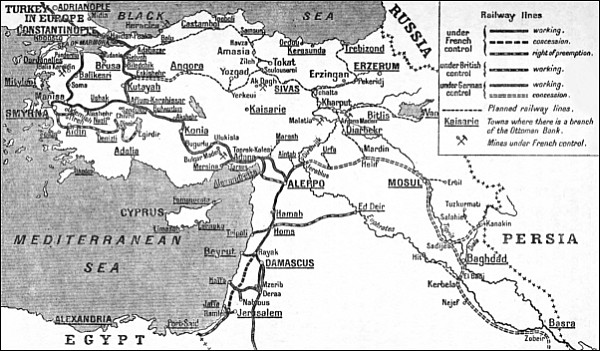
During the reign of Abdul Hamid, owing to the facilities given by this state of things, the interference of the Powers in Turkish affairs reached such a climax that they succeeded not only in bringing Turkey into a condition of subjection, but in disposing of her territories, after dividing them into regions where their respective influence was paramount. The greediness of the Powers was only restrained by the conflicts their rivalry threatened to raise. If one of them obtained a concession, such as the building24 of a railway line in the region assigned to it, the others at once demanded compensation, such as the opening of harbours on the sea-fronts assigned to them. Things went so far that Russia, though she could not compete with the Powers whose rivalry gave itself free scope at the expense of the Ottoman Empire, intervened to hinder Turkey from constructing a system of railways in Eastern Asia Minor, alleging that the building of these lines would endanger her zone of influence. The railway concessions had to be given to her, though she never attempted to construct any of the lines.
In addition, by laying stress on the Capitulations, in which nothing could be found that supported their demands, the Great Powers established foreign post-offices in the ports of the Empire. These post-offices, which enjoyed the privilege of extra-territoriality, were only used by foreign merchants and persons of note to smuggle in small parcels, and by native agitators to correspond safely with agitators living abroad.
Of course Turkey, being thus brought into subjection, did not develop so rapidly as the nations which, not being under any foreign tutelage, enjoyed independence; and it is unfair to reproach her with keeping behind them.
After the revolution, and owing to many requests of the Turkish Government, some economic alterations were made in the Capitulations, such as the paying of the tradesman’s licence tax by foreigners, and the right of the State to establish monopolies. Austria-Hungary, when the question of Bosnia-Herzegovina was settled, consented to give up her privilege concerning the customs duties, on condition that other25 Powers did the same. A short time after Germany promised to do so, but, among the other Powers, some refused, and others laid down conditions that would have brought more servitude to Turkey and would have cost her new sacrifices.
The Unionist Government, as will be shown later, cancelled the Capitulations during the last war.
After recalling the wonderful political fortune of the Turkish Empire, we should remember that, after bringing Eastern influences to Western countries, it had also an influence of its own which was plainly felt in Europe. Western art drew its inspiration from Eastern subjects, and at the end of the eighteenth century everything that was Turkish became the fashion for a time.
This influence was the natural outcome of the close intercourse with the Levant from the Renaissance till the eighteenth century, and of the receptions given in honour of Eastern men of mark during their visits to European courts. It is not intended to discuss the question of the relation between Turkish art and Arabian art, and its repercussion on Western art, or of Eastern influence in literature; but it will be well to show how much attraction all Turkish and Eastern things had for the people of the time, and how happily the imitation of the East influenced decorative art and style, as if the widely different tastes of societies so far apart had reached the same stage of refinement and culture.
Records are still extant of the famous embassy sent by the Grand Turk during the reign of Louis XIV,26 and the embassy sent by the Sultan of Morocco to ask for the hand of the Princess de Conti, for in Coypel’s painting in the Versailles Museum can be seen the ambassadors of the Sultan of Morocco witnessing a performance of Italian comedy in Paris in 1682. Later on the Turkish embassy of Mehemet Effendi in 1721 was painted by Ch. Parrocel.
Lievins’ “Soliman” in the Royal Palace of Berlin, a few faces drawn by Rembrandt, his famous portrait known as “The Turk with the Stick” in MacK. Tomby’s collection, which is more likely to be the portrait of an aristocratic Slav, the carpet in “Bethsabe’s Toilet after a Bath,” bear witness to the Eastern influence. So do the Turkish buildings of Peter Koeck d’Aelst, who was the director of a Flemish manufactory of tapestry at Constantinople during Soliman’s reign; the scenes of Turkish life and paintings of Melchior Lorch, who also lived at Constantinople about the same time and drew the Sultan’s and the Sultana’s portraits; and the pictures of J.-B. van Mour, born at Valenciennes, who died in Constantinople, where he had been induced to come by M. de Ferriol, the French King’s Ambassador; of A. de Favray; and of Melling, the Sultana Hadidge’s architect, who was called the painter of the Bosphorus.9
There may also be mentioned Charles Amédée van Loo’s pictures: “A Sultana’s Toilet,” “The Sultana ordering the Odalisks some Fancy Work,” “The Favourite Sultana with her Women attended by White27 and Black Eunuchs,” “Odalisks dancing before the Sultan and Sultana,” most of which were drawn for the king from 1775 to 1777, and were intended as models for tapestries; and also the portrait of Madame de Pompadour as an odalisk, “The Odalisk before her Embroidery Frame,” and “A Negress bringing the Sultana’s Coffee,” by the same painter. To these may be added Lancret’s Turkish sketches, the drawings and pastels of Liotard, who left Geneva for Paris about 1762, then lived in the ports of the Levant and Constantinople, and came back to Vienna, London, and Holland, and whose chief pictures are: “A Frankish Lady of Pera receiving a Visit,” “A Frankish Lady of Galata attended by her Slave”; and also Fragonard’s “New Odalisks introduced to the Pasha,” his sepia drawings, Marie Antoinette’s so-called Turkish furniture, etc.
In music any sharp, brisk rhythm was styled alla turca—that is, in the Turkish style. We also know a Turkish roundelay by Mozart, and a Turkish march in Beethoven’s “Ruins of Athens.”
At the end of the eighteenth century, not only did people imitate the gorgeousness and vivid colours of Turkish costumes, but every Turkish whim was the fashion of the day. Ingres, too, took from Turkey the subjects of some of his best and most famous paintings: “The Odalisk lying on her Bed,” “The Turkish Bath,” etc.
Lastly, the Great War should teach us, in other respects too, not to underrate those who became our adversaries owing to the mistake they made in28 joining the Central Powers. For the “Sick Man” raised an army of nearly 1,600,000 men, about a million of whom belonged to fighting units, and the alliance of Turkey with Germany was a heavy blow to the Allied Powers: Russia was blockaded, the Tsar Ferdinand was enabled to attack Serbia, the blockade of Rumania brought on the peace of Bukharest, Turkish troops threatened Persia, owing to which German emissaries found their way into Afghanistan, General Kress von Kressenstein and his Ottoman troops attacked the Suez Canal, etc. All this gave the Allies a right to enforce on Turkey heavy terms of peace, but did not justify either the harsh treatment inflicted upon her before the treaty was signed, or some of the provisions of that treaty. It would be a great mistake to look upon Turkey as of no account in the future, and to believe that the nation can no longer play an important part in Europe.
PARTVII 2 THE TURKS AND EUROPE
https://www.gutenberg.org/files/51761/51761-h/51761-h.htm
THE TURKS AND EUROPE
I
THE TURKS
The peoples who speak the various Turkish dialects and who bear the generic name of Turcomans, or Turco-Tatars, are distributed over huge territories occupying nearly half of Asia and an important part of Eastern Europe. But as we are only considering the Turkish question from the European point of view, no lengthy reference is needed to such Eastern groups as those of Turkish or Mongol descent who are connected with the Yenisseians of Northern Asia and the Altaians. The Russians call these peoples Tatars, and they, no doubt, constituted the “Tubbat” nation, referred to by the Chinese historians under the name of “Tou-Kiou” up to the seventh century after Christ. These very brief facts show the importance of the race and are also sufficient to emphasise the point that these people are akin to those Turks of Western Asia who are more closely connected with the Europeans.
The Western Turkish group includes the Turcomans of Persia and Russian or Afghan Turkistan; the Azerbaïjanians, who are probably Turkisised Iranians, living between the Caucasus Mountains and Persia; and, lastly, the Osmanli Turks, who are subjects of the Sultan, speak the Turkish language, and profess Islam.
Close to this group, but farther to the East, the central group also concerns us, for some of its representatives who now inhabit the boundaries of Europe made repeated incursions into Europe in various directions. In the plains lying between the River Irtish and the Caspian Sea live the Kirghiz-Kazaks, and in the Tien-Shien Mountains the Kara-Kirghiz, who have preserved many ancient Old Turkish customs, and seem to have been only slightly Mohammedanised. The Usbegs and the Sartis of Russian Turkistan, on the other hand, have been more or less Iranised. Finally, on the banks of the Volga are to be found the Tatars of European Russia. Among them the Tatars of Kazan, who are descended from the Kiptchaks, came to the banks of the Volga in the thirteenth century and mingled with the Bulgars. These Tatars differ from the Tatars of Astrakhan, who are descendants of the Turco-Mongols of the Golden Horde, and are connected with the Khazars, and from the Nogaïs of the Crimea, who are Tatars of the steppes who more or less inter-married with other races—the Tatars of the Tauris coast being the hybrid descendants of the Adriatic race and the Indo-Afghan race. They are to be found near Astrakhan and in the Caucasus Mountains, and even, perhaps, as far as Lithuania, “where, though still being Mohammedans, they have adopted the language and costume of the Poles.”1
The invasion of Europe by the Turks appears as the last great ethnic movement that followed the3 so-called period of migration of peoples (second to sixth centuries a.d.) and the successive movements it entailed.
Let us consider only the migrations of those who concern us most closely, and with whom the Turks were to come into contact later on. First the Slavs spread westward towards the Baltic and beyond the Elbe, and southward to the valley of the Danube and the Balkan Peninsula. This movement brought about the advance of the Germans towards the west, and consequently the advance of the Celts towards Iberia and as far as Spain. Owing to the invasion of the Huns in the fifth century and in the sixth of the Avars, who, after coming as far as Champagne, settled down in the plains of Hungary and the territories lying farther to the south which had already been occupied by the Dacians for several centuries, the Slavs were cut into two groups. About the same time, the Bulgars came from the banks of the Volga and settled on the banks of the Danube.
In the ninth century, owing to a new migration of masses of Slavonic descent, the Hungarians, driven by tribes of Petchenegs and Polovts into Southern Russia, crossed the Carpathian Mountains and took up their abode in the valley of the Tirzah. While the Magyar Turks settled in Hungary, the Kajar Turks occupied the hinterland of Thessalonica in Macedonia. In the twelfth century, the Germans, driving the Western Slavs as far as the banks of the Vistula, brought about a reaction towards the north-east of the Eastern Slavs, whose expansion took place at the expense of the Finnish tribes that lived there.
Only in the thirteenth century did the Turco-Mongols4 begin to migrate in their turn; they occupied the whole of Russia, as far as Novgorod to the north, and reached Liegnitz in Silesia. But, although they soon drew back from Western Europe, they remained till the fifteenth century in Eastern Russia, and in the eighteenth century they were still in the steppes of Southern Russia, and in the Crimea.
Finally, in the fourteenth and fifteenth centuries, the Osmanli Turks invaded the Balkan Peninsula, where they met such of their kindred as the Kajars, the Tchitaks, and the Pomaks, who were heathens or Christians, and later on embraced Islam. They invaded Hungary and made incursions into Lower Austria.
Then began the migration of the Little Russians into the upper valley of the Dnieper, and in the sixteenth century they set off towards the steppes of Southern Russia, while the Great Russians began to advance beyond the Volga towards the Ural, a movement which reached Siberia, and still continues.
It follows, necessarily, that in the course of these huge migrations, the so-called Turkish race was greatly modified; the Turks of the Eastern group mixed with the Mongols, the Tunguses, and the Ugrians; and those of the Western group in Asia and Europe with various Indo-Afghan, Assyrian, Arab, and European elements, especially with those living near the Adriatic: the Greeks, the Genoese, the Goths, etc. Thus the Osmanli Turks became a mixture of many races.
Though ethnologists do not agree about the various ethnic elements of the Turco-Tatar group, it is certain, all the same, that those who came to Asia Minor early5 associated for a long time with the people of Central Asia, and Vambéry considers that a Turkish element penetrated into Europe at a very early date.2
Though the Arabs in the seventh century subdued the Turks of Khiva, they did not prevent them from penetrating into Asia Minor, and the Kajars, who were not Mohammedans, founded an empire there in the eighth century. At that period the Turks, among whom Islam was gaining ground, enlisted in the Khalifa’s armies, but were not wholly swallowed up by the Arab and Moslem civilisation of the Seljukian dynasty, the first representatives of which had possibly embraced Nestorian Christianity or Islam. Henceforth Asia Minor, whence the previous Turkish elements had almost disappeared, began to turn into a Turkish country.
All the Turks nowadays are Mohammedans, except the Chuvashes (Ugrians) who are Christians, and some Shamanist Yakuts.
As will be shown later on, these ethnographic considerations should not be neglected in settling the future conditions of the Turks and Slavs in Europe, in the interest of European civilisation.
About half a century ago Elisée Reclus wrote as follows:
“For many years has the cry ‘Out of Europe’ been uttered not only against the Osmanli leaders, but also against the Turks as a whole, and it is well known that this cruel wish has partly been fulfilled; hundreds of thousands of Muslim emigrants from Greek Thessaly, Macedonia, Thrace, and6 Bulgaria have sought refuge in Asia Minor, and these fugitives are only the remnants of the wretched people who had to leave their ancestral abodes; the exodus is still going on, and, most likely, will not leave off till the whole of Lower Rumelia has become European in language and customs. But now the Turks are being threatened even in Asia. A new cry arises, ‘Into the Steppes,’ and to our dismay we wonder whether this wish will not be carried out too. Is no conciliation possible between the hostile races, and must the unity of civilisation be obtained by the sacrifice of whole peoples, especially those that are the most conspicuous for the noblest qualities—uprightness, self-respect, courage, and tolerance?”3
For a long time this state of affairs did not seem to change much, but after the recent upheaval of Europe it has suddenly become worse.
Very different races, who have more or less intermingled, live on either side of the Bosphorus, for Elisée Reclus says:
“The Peninsula, the western end of the fore part of the continent, was a place where the warlike, wandering, or trading tribes, coming from the south-east and north-east, converged naturally. Semitic peoples inhabited the southern parts of Anatolia, and in the centre of that country their race, dialects, and names seem to have prevailed among numerous populations; in the south-west they seem to have intermingled with coloured men, perhaps the Kushits. In the eastern provinces the chief ethnic elements seem to have been connected with the Persians, and spoke languages akin to Zend; others represented the northern immigrants that bore the generic name of Turanians. In the West migrations took place in a contrary direction to those that came down from the Armenian uplands; Thracians were connected by their trade and civilisation with the coastlands of Europe and Asia sloping towards the Propontis, and between both parts of the world Greeks continually plied across the Ægean Sea.”4
Thus the common name of “Turks” is wrongly given to some Moslem elements of widely different origin, who are to be found in Rumelia and Turkey-in-Asia,7 such as the Albanians, who are akin to Greeks through their common ancestors, the Pelasgians, the Bosnians, and the Moslem Bulgars, the offspring of the Georgian and Circassian women who filled the harems, and the descendants of Arabs or even of African negroes.
After the internal conflicts between some of these elements, the quarrels with other foreign elements, and the keen rivalry which existed generally, each section seems to have held the Turk responsible for whatever wrong was done, and the Turk was charged with being the cause of all misfortunes—almost in the same way as the Jews: the Turks have become, as it were, the scapegoats.
Yet, in 1665, in his account of his travels in the East, M. de Thévenot, who died at Mianeh in 1667, praised Turkish morality and tolerance.
Elisée Reclus wrote:
“Turkish domination is merely outward, and does not reach, so to say, the inner soul; so, in many respects, various ethnic groups in Turkey enjoy a fuller autonomy than in the most advanced countries of Western Europe.”
Ubicini speaks in the same manner, and Sir H. Bulwer states that:
“As to freedom of faith and conscience, the prevailing religion in Turkey grants the other religions a tolerance that is seldom met with in Christian countries.”
Unfortunately the Turk’s mentality, in spite of what his enemies say, does not help him. Owing to his nature, he is quite unable to defend himself and to silence his slanderers.
For, as E. Reclus remarked:
“They are not able to cope with the Greeks, who, under pretence of pacific dealings, take vengeance for the war of 8extermination, the traces of which are still to be seen in Cydonia and Chio. They do not stand an equal chance of winning; most of them only know their own language, while a Greek speaks several languages; they are ignorant and artless by the side of clever, shrewd adversaries. Though he is not lazy, the Turk does not like to hurry; ‘Haste is devilish, patience is godly,’ he will often say. He cannot do without his ‘kief,’ an idle dream in which he lives like a mere plant, without any exertion of his mind and will, whereas his rival, always in earnest, can derive profit even from his hours of rest. The very qualities of the Turk do him harm: honest, trustworthy, he will work to the end of his life to pay off a debt, and the business man takes advantage of this to offer him long credits that shall make a slave of him for ever. There is an axiom among business men in Asia Minor: ‘If you wish to thrive, do not grant a Christian more credit than one-tenth of his fortune; risk ten times as much with a Mohammedan.’ Encumbered with such a credit, the Turk no longer possesses anything of his own; all the produce of his work will go to the usurer. His carpets, his wares, his flocks, even his land, will pass gradually into the hands of the foreigner.”5
But since the time when this was written the Turkish mind has changed. The Turks have set to work to learn languages, especially French. A large part of the younger generation concern themselves with what takes place in the West, and this transformation, which the Greeks and other Europeans looked upon as endangering their situation in Turkey, may be one of the factors of the present conflict.
Besides, E. Reclus added: “The Greeks already hold, to the great prejudice of the Turks, numerous industries and all the so-called liberal professions, and as dragomans and journalists they are the only informers of the Europeans, and control public opinion in the West.
Mag-subscribe sa:
Mga Komento (Atom)